Weighted Vest 10kg: A UK Guide to Rucking and Hyrox Prep
TL;DR: A weighted vest 10kg is an advanced load, best suited to rucking, Hyrox-style engine work and loaded calisthenics. Worn snug against the torso it beats a rucksack for anything that mixes moving and floor work — but it is a poor first vest, and a poor companion for long runs. This guide covers who 10kg actually suits, and how to get there without wrecking your joints.
Who should (and should not) buy a 10kg vest
The 10kg option exists for experienced athletes: people doing calisthenics, rucking or race-prep conditioning who have already spent months under lighter load. If you can move through an hour of brisk loaded walking or a full bodyweight session at 8kg with clean technique and no next-day joint complaints, 10kg is a rational next step. If you are new to loaded training, it is not — start lighter and progress. A useful gut-check: 10kg should be roughly 10–15% of your bodyweight or less; above that, everything from posture to breathing gets compromised faster than fitness improves.
Vest or rucksack for rucking?
Rucking with a loaded backpack works until it doesn't: hard frames dig into your back, narrow straps chew your shoulders over long miles, and the mass swings behind you on rough ground. A vest solves the geometry — load wrapped evenly around your torso, front and back, with nothing levering off your shoulders.
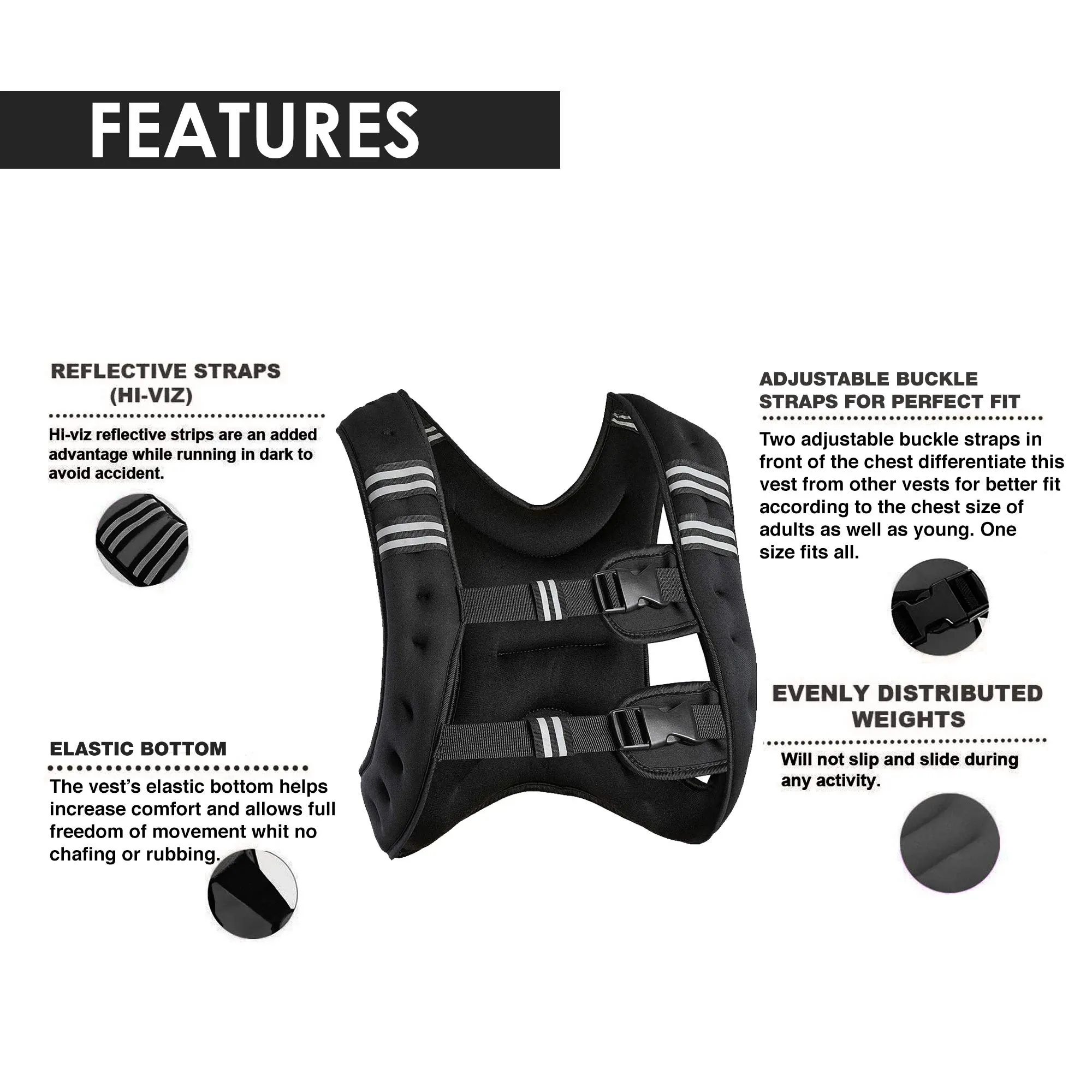
The detail that matters at 10kg is what the weight does inside the vest over hours. Loose filler gradually sags to the bottom hem and turns the vest into a pendulum. The FitnessVest Pro-Series 10kg seals its iron sand into separate sewn-in compartments, so the centre of gravity stays where it was fitted — the difference between a vest that still sits square at mile eight and one you keep hitching back up.
Using 10kg for Hyrox-style prep
Hyrox-style events alternate running with functional stations, which is exactly the pattern a vest trains well: compromised running, loaded carries, lunges and wall-ball conditioning in one garment. To be accurate about the rules: weight vests are permitted at HYROX events provided they do not interfere with other racers — they are not a required part of any division's standard kit. Treat the vest as a training multiplier for engine sessions, not race-day equipment you must own.
A simple weekly pattern: one loaded walk (45–90 minutes), one vest conditioning piece (station work plus short runs), and the rest of your training unloaded so speed and technique stay honest.
A sensible route from 5kg to 10kg
- 5kg for 6–8 weeks: loaded walks and easy circuits until the vest disappears into the background.
- 8kg for another block: HIIT and strength-biased bodyweight work; watch next-day knees and hips, not just session performance.
- 10kg when 8kg is quiet: begin with walking and low-rep calisthenics only, then widen the menu.
If you would rather make that journey inside one garment, an adjustable weighted vest is the alternative — accepting that removable plates bring their own rattle and faff at the top end.
Can you run in a 10kg vest?
Mostly, no — not for distance. Ten kilograms multiplies impact through knees and shins with every stride, so runners use it for short hill repeats and strides at most. The weighted vest for running guide covers loads, programming and when running loaded is a bad idea; for steady miles under 10kg, walk them.
Keeping 10kg stable: fit checks that matter
- Dual front buckles plus side straps, tensioned so a deep breath is still easy — then no tighter.
- Shoulder coverage broad enough that load spreads across the trapezius, not a strap edge.
- A mesh back panel — under 10kg you will generate serious heat even in a British winter.
- Reflective detailing if any of your rucking happens on winter roads at dusk.
- At £198.95 (RRP £110.91) with 30-day returns, test it loaded indoors first — a wrong-weight decision is reversible.
Frequently asked questions
Is 10kg too heavy for a first weighted vest?
For almost everyone, yes. Start at 5kg — or 8kg if you already train hard — and treat 10kg as a milestone you earn over a few months, not an entry point.
Is 10kg enough for Hyrox training?
For training purposes, comfortably — it makes compromised running and station work meaningfully harder. Races do not require a vest in standard divisions, so there is no target number to match; 10kg is a demanding, practical ceiling for most athletes' conditioning.
Can I remove weight from the 10kg vest for easier days?
Not on this design — the iron sand is sewn into fixed compartments, which is what keeps it stable. If you want lighter days, that is what the 5kg and 8kg versions (or an adjustable vest) are for.
How do I stop a 10kg vest bouncing?
Fit, not willpower: cinch both front buckles and the side straps until the vest moves with your ribcage, and re-tension after ten minutes once the shell has settled onto your shoulders.
Ready to level up with FitnessVest?
Shop Now — £198.95